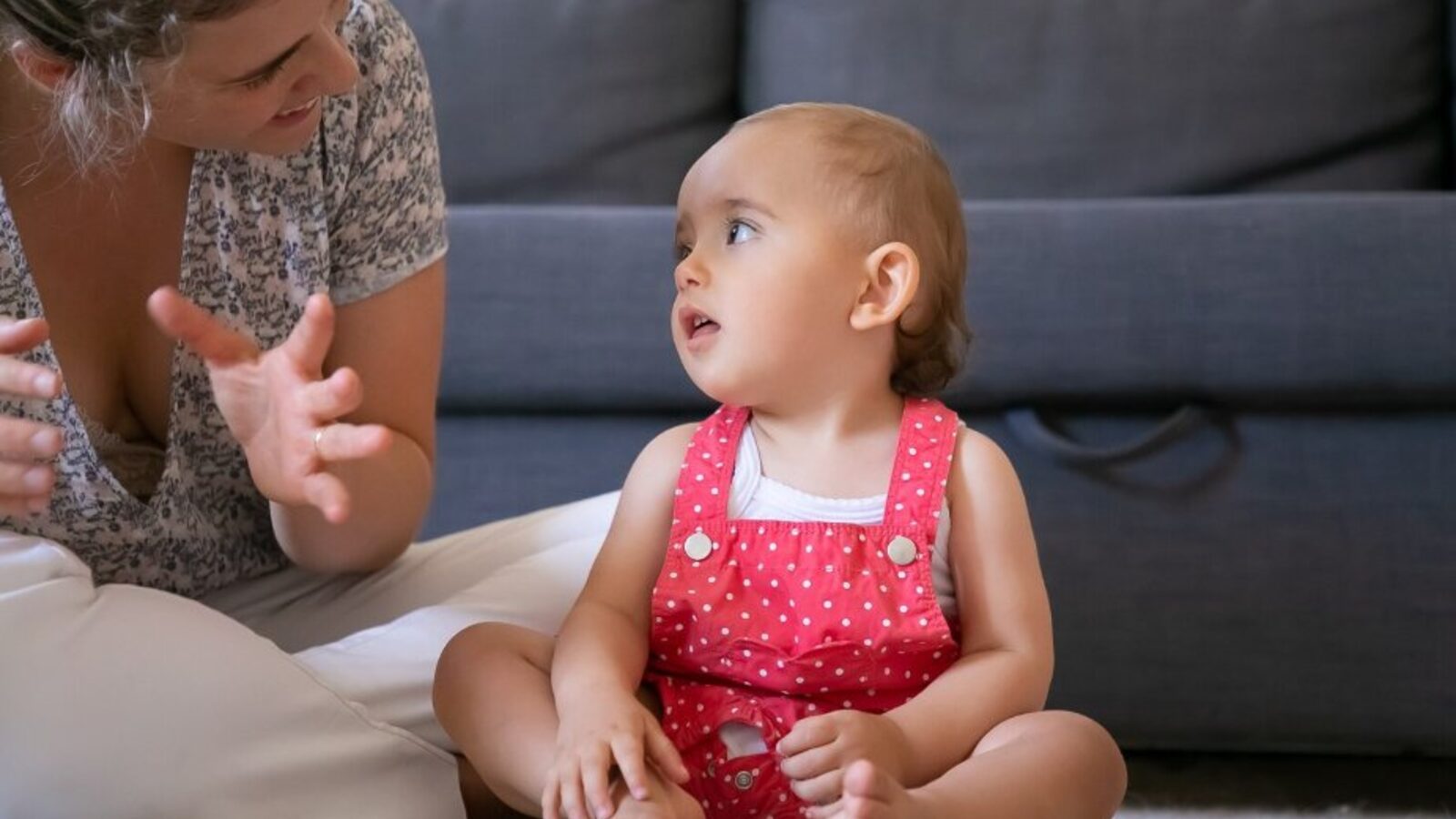
Communication isn't a switch that flips when a baby says "mama" for the first time. It starts the day they're born. A cry is communication. So is a held gaze. So is the way a six-week-old turns their head towards your voice.
Speech and language develop in a rough order across the first year. Knowing the order means you can recognise what's happening when it happens, support it where you can, and notice when something needs a closer look from your public health nurse.
The first-year arc, briefly
Roughly speaking:
- 0 to 2 months. Cries to communicate. Throaty gurgles. Recognises your voice. Prefers high-pitched voices.
- 2 to 3 months. Cooing. Echoes back simple sounds ("ooh", "aah"). Laughs out loud by three months.
- 4 to 5 months. "Ah-goo" sounds. Vocalises when you stop talking, like taking a turn in conversation. Copies your voice. Raspberry-spitting noises.
- 6 to 9 months. Babbling. Strings of consonant sounds: "baba", "gagaga", "dada", "mama". Not first words yet, just the practice. Turns towards new sounds.
- 10 to 12 months. First real words start appearing for many babies. Usually one or two by twelve months. Some are later, which is also normal.
The HSE schedules don't pin first words to twelve months on the dot. Some babies are talking by ten. Some are still mostly babbling at fifteen. The pattern is what matters: receptive language (understanding) usually runs ahead of expressive language (talking), and both should be moving forward across the months.
What HSE says parents can do
The official HSE guidance on supporting communication from 0 to 12 months is plain and practical. The headline things:
Get face-to-face
Roughly arm's length apart. That's the distance babies focus on best in the early months. Make eye contact. Smile. Let them see your face do what your voice does.
Talk to them, even when they can't talk back
Narrate what you're doing. Point things out. Repeat words to help them stick. "The cat. The cat is sleeping. Bye bye cat." Babies listen long before they can answer.
Leave pauses
This is the one most parents don't think about. When you ask your baby a question or make a sound, pause for a beat afterwards. Give them the chance to take a turn. Even a four-month-old will fill that pause with a coo or a movement. That back-and-forth is how conversation starts.
Copy their sounds
If they make a noise, make the same noise back. This isn't silly. It's how they learn that the noises they make matter, that someone's listening, that this is a thing they can do on purpose.
Turn the TV off
HSE is explicit about this. Background noise from screens or radios makes it harder for babies to pick out the speech sounds you're making. Quiet wins.
Read picture books together
Doesn't matter if you read all the words or skip pages. The point is the closeness, the pointing, the talking about what's on the page. Board books, pop-up books, touch-and-feel books are all good. Babies hold them, chew them, throw them. That's all part of it.
Sing
Nursery rhymes and songs are powerful for the same reason adults remember song lyrics for decades: repetition, rhythm and tune lock language in. You don't have to be good at singing. Your baby isn't grading you.
If you speak more than one language at home
This question comes up a lot in Irish households where one parent or grandparent speaks a different first language. The HSE's position is unambiguous: talk to your baby in whichever language you're most comfortable with. Children adapt to multiple languages quickly. Speaking your native language at home supports both understanding and talking, and makes learning other languages easier later, including English.
If you and your partner use different languages, that's fine too. Babies sort it out.
Screen time, for the record
The HSE separately publishes guidance on screen time for young children. The short version for under-twos is: avoid it where you can, keep it brief and shared when you can't. Screens can't teach babies to communicate in the way that another person can. The interaction is the point.
When to talk to your PHN or GP
From the HSE's milestone lists for the first six months, the communication-related red flags are:
- Doesn't startle to loud noises (newborn)
- Doesn't engage in eye contact (2 to 4 months)
- Doesn't smile in response to you (3 months)
- Doesn't coo or make sounds (4 months)
- Doesn't chuckle or laugh (5 months)
- Doesn't turn towards sounds or familiar voices (6 months)
- Loses skills they previously had (any age)
The last one matters most. A baby moving forward is fine, even if slowly. A baby losing skills is the situation where the HSE explicitly says to ring your public health nurse, not wait.
Hearing checks happen around the time of birth in Ireland for most babies, and again at developmental checks. If you have any concern that your baby isn't hearing you properly, you can ask for a re-check.
The unglamorous truth
Most of what helps a baby learn to communicate is just paying attention to them. Looking at them. Pausing to let them respond. Talking about whatever's in front of you. There's no special programme, no required toy, no app that does it better than another person who's actually looking at the baby.
Log the firsts you'll forget you noticed.
Lullagram's Milestones screen has slots for first smile, first laugh, first babble and first word, ready when they happen. Free for 7 days.
Get Lullagram on Google Play